Original post on: https://ceoworld.biz/2026/06/28/cultural-assertive-agility-are-you-truly-leading-or-just-exporting-your-own-style/#google_vignette
C-suite leaders don’t lead in one culture; they operate across many. You negotiate billion-dollar deals in Beijing, align multicultural executive teams in Frankfurt, and present to boards in New York or São Paulo. In this environment, one trait can make or break your effectiveness:
How Assertive Leadership is demonstrated.
In New York, decisive, conviction-driven leadership signals strength. In Tokyo, the same directness can unintentionally erode trust. The behavior hasn’t changed. The cultural lens has.
The question facing every global executive is no longer whether to be assertive, but how to express it so it lands with impact.
The answer is Cultural Assertive Agility – the ability to lead with strong, clear conviction while adjusting how you say things to fit different cultures. It is not about being less assertive. It is about being smart and effective.
Assertiveness Is Contextual – Leadership Impact Is Not
Having advised more than 10,000 C-suite executives on high-stakes leadership communication – including U.S. diplomats – I have consistently observed that frameworks that deliver exceptional results in one market can produce unintended consequences in another.
- A CEO praised in Silicon Valley for making fast decisions may find progress slows in Japan, where building consensus is often viewed as a sign of maturity and respect.
- A German executive’s direct, fact-based feedback may strengthen credibility in Berlin, but can feel overly blunt in parts of Latin America, where relationships strongly shape how messages are received.
- A Nordic leader’s collaborative style, which empowers teams in Stockholm, may be misinterpreted in high power-distance cultures as a lack of clear direction.
Leadership principles are universal. Execution behaviors are not. The most respected global executives master the translation.
The RCCE® Framework: A Global Operating Model for Cultural Assertive Agility
Cultural Assertive Agility is not about changing your values or diluting your edge. It is about ensuring your leadership is received as intended. Use this practical four-step framework in every critical interaction:
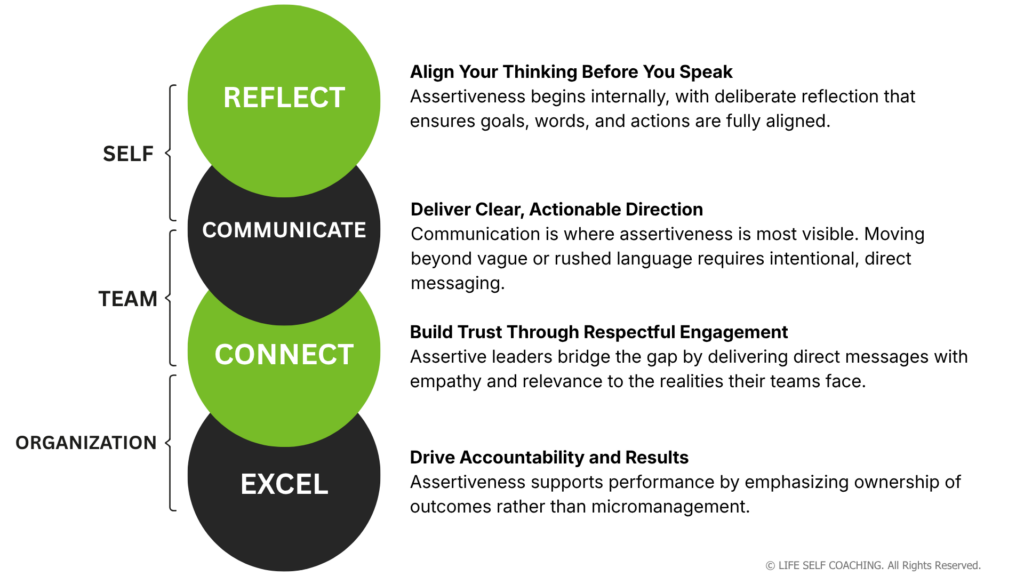
1. Reflect: Before any major communication or decision, top executives create space to diagnose context. Ask yourself:
- What is the strategic objective?
- How does this culture view authority, feedback, and decision-making?
- What must stay non-negotiable (core values and outcomes), and what can be adapted (style and timing)?
Build a 60-second cultural brief before key meetings. Reflection prevents instinctive home-culture defaults and turns reactions into intentional leadership.
2. Communicate: Assertiveness is judged by impact, not volume. Adapt delivery without softening substance:
- Directness: High in Germany and the U.S.; calibrate lower and more indirect in Japan or China.
- Consensus: Seek private alignment (nemawashi) in consensus-driven markets before public commitment.
- Feedback: Public critique builds sharpness in some cultures; private conversations preserve dignity and trust in others.
Listen aggressively for both spoken and unspoken signals. The best global leaders spot resistance early and address it before it becomes a problem.
3. Connect: In every culture, people follow leaders who make them feel respected. Build relational capital by:
- Demonstrating genuine curiosity before asserting conclusions.
- Delivering tough messages without diminishing dignity.
- Balancing authority with psychological safety.
4. Excel: Never compromise outcomes. Culturally agile C-suite leaders:
- Set clear expectations and accountability mechanisms that work locally.
- Make timely decisions without sacrificing buy-in.
- Drive execution while sustaining trust.
Excellence means raising the bar while helping diverse teams reach it.
Principles That Work Everywhere
While expression changes, these traits earn respect everywhere:
- Integrity and consistency
- Respect and active listening
- Clarity paired with humility
- Accountability paired with empathy
- Continuous learning and psychological safety
These are your anchors. Cultural agility is how you express them powerfully across borders.
In the next decade, the most valuable executives won’t be the loudest. They will be the ones who master assertive leadership by knowing exactly when to challenge, when to listen, when to decide fast, and when to build consensus – all while staying true to their core.